


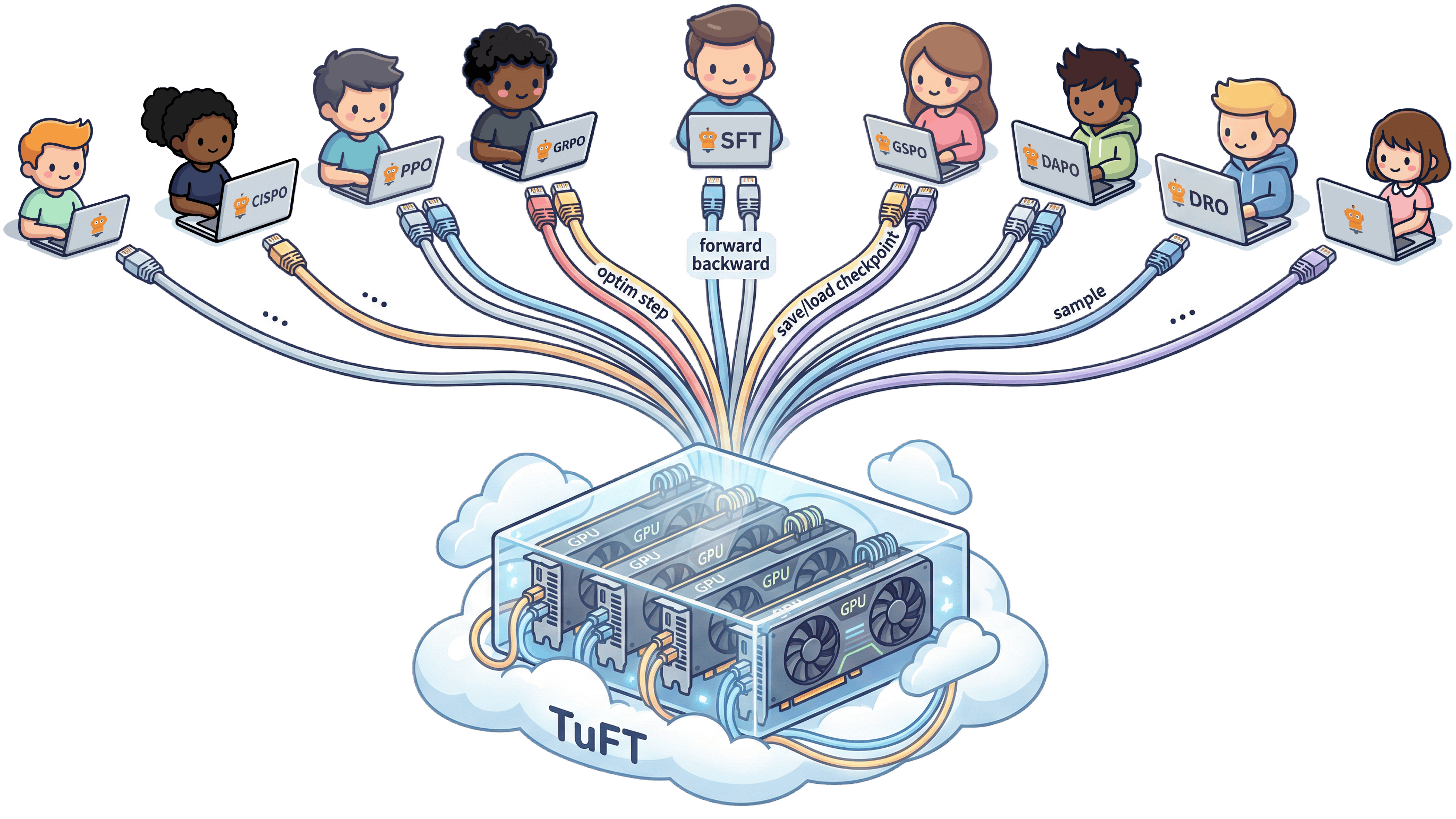
TuFT (Tenant-unified FineTuning) is a multi-tenant platform that lets multiple users fine-tune LLMs on shared infrastructure through a unified API. Access it via the Tinker SDK or compatible clients.
Check out our roadmap to see what we're building next.
We're open source and welcome contributions! Join the community:
- Quick Install
- Quick Start Example
- Installation
- Use the Pre-built Docker Image
- User Guide
- Architecture
- Roadmap
- Development
Note: This script supports unix platforms. For other platforms, see Installation.
Install TuFT with a single command:
/bin/bash -c "$(curl -fsSL https://raw.githubusercontent.com/agentscope-ai/tuft/main/scripts/install.sh)"This installs TuFT with full backend support (GPU dependencies, persistence, flash-attn) and a bundled Python environment to ~/.tuft. After installation, restart your terminal and run:
tuftThis example demonstrates how to use TuFT for training and sampling with the Tinker SDK. Make sure the server is running on port 10610 before running the code. See the Run the server section below for instructions on starting the server.
Prepare your training data in the format expected by TuFT:
import tinker
from tinker import types

# Connect to the running TuFT server
client = tinker.ServiceClient(base_url="http://localhost:10610", api_key="local-dev-key")

# Discover available base models
capabilities = client.get_server_capabilities()
base_model = capabilities.supported_models[0].model_name

print("Supported models:")
for model in capabilities.supported_models:
    print("-", model.model_name or "(unknown)")

# Prepare training data
# In practice, you would use a tokenizer:
# tokenizer = training.get_tokenizer()
# prompt_tokens = tokenizer.encode("Hello from TuFT")
# target_tokens = tokenizer.encode(" Generalizing beyond the prompt")

# For this example, we use fake token IDs
prompt_tokens = [101, 42, 37, 102]
target_tokens = [101, 99, 73, 102]

datum = types.Datum(
    model_input=types.ModelInput.from_ints(prompt_tokens),
    loss_fn_inputs={
        "target_tokens": types.TensorData(
            data=target_tokens,
            dtype="int64",
            shape=[len(target_tokens)]
        ),
        "weights": types.TensorData(data=[1.0, 1.0, 1.0, 1.0], dtype="float32", shape=[4])
    },
)
Example Output:
Supported models:
- Qwen/Qwen3-4B
- Qwen/Qwen3-8B
Create a LoRA training client and perform forward/backward passes with optimizer steps:
# Create a LoRA training client
training = client.create_lora_training_client(base_model=base_model, rank=8)

# Run forward/backward pass
fwdbwd = training.forward_backward([datum], "cross_entropy").result(timeout=30)
print("Loss metrics:", fwdbwd.metrics)

# Apply optimizer update
optim = training.optim_step(types.AdamParams(learning_rate=1e-4)).result(timeout=30)
print("Optimizer metrics:", optim.metrics)
Example Output:
Loss metrics: {'loss:sum': 2.345, 'step:max': 0.0, 'grad_norm:mean': 0.123}
Optimizer metrics: {'learning_rate:mean': 0.0001, 'step:max': 1.0, 'update_norm:mean': 0.045}
Save the trained model checkpoint and sampler weights:
# Save checkpoint for training resumption
checkpoint = training.save_state("demo-checkpoint").result(timeout=60)
print("Checkpoint saved to:", checkpoint.path)

# Save sampler weights for inference
sampler_weights = training.save_weights_for_sampler("demo-sampler").result(timeout=60)
print("Sampler weights saved to:", sampler_weights.path)

# Inspect session information
rest = client.create_rest_client()
session_id = client.holder.get_session_id()
session_info = rest.get_session(session_id).result(timeout=30)
print("Session contains training runs:", session_info.training_run_ids)
Example Output:
Checkpoint saved to: tinker://550e8400-e29b-41d4-a716-446655440000/weights/checkpoint-001
Sampler weights saved to: tinker://550e8400-e29b-41d4-a716-446655440000/sampler_weights/sampler-001
Session contains training runs: ['550e8400-e29b-41d4-a716-446655440000']
Load the saved weights and generate tokens:
# Create a sampling client with saved weights
sampling = client.create_sampling_client(model_path=sampler_weights.path)

# Prepare prompt for sampling
# sample_prompt = tokenizer.encode("Tell me something inspiring.")
sample_prompt = [101, 57, 12, 7, 102]

# Generate tokens
sample = sampling.sample(
    prompt=types.ModelInput.from_ints(sample_prompt),
    num_samples=1,
    sampling_params=types.SamplingParams(max_tokens=5, temperature=0.5),
).result(timeout=30)

if sample.sequences:
    print("Sample tokens:", sample.sequences[0].tokens)
    # Decode tokens to text:
    # sample_text = tokenizer.decode(sample.sequences[0].tokens)
    # print("Generated text:", sample_text)
Example Output:
Sample tokens: [101, 57, 12, 7, 42, 102]
Note: Replace fake token IDs with actual tokenizer calls when you have a tokenizer available locally.
Tip: For a quick one-command setup, see Quick Install. This section is for users who prefer to manage their own Python environment or need more control over the installation.
We recommend using uv for dependency management.
-
Clone the repository:
git clone https://github.com/agentscope-ai/TuFT
Potential environment issues:
TuFT relies on open-source platforms, so it may not function correctly if your environment lacks access to these resources. To help you diagnose connectivity or dependency issues, we provide a diagnostic script that checks the status of required prerequisites:
cd TuFT
bash scripts/env_check.sh
This script will assess your environment status and suggest possible solutions.
-
Create a virtual environment:
cd TuFT uv venv --python 3.12 -
Activate environment:
source .venv/bin/activate -
Install dependencies:
# Install minimal dependencies for non-development installs
uv sync

# If you need to develop or run tests, install dev dependencies
uv sync --extra dev

# If you want to run the full feature set (e.g., model serving, persistence),
# please install all dependencies
uv sync --all-extras
python scripts/install_flash_attn.py
# If you face issues with flash-attn installation, you can try installing it manually:
# uv pip install flash-attn --no-build-isolation
You can also install TuFT directly from PyPI:
uv pip install tuft

# Install optional dependencies as needed
uv pip install "tuft[dev,backend,persistence,examples]"The CLI starts a FastAPI server:
tuft launch --port 10610 --config /path/to/tuft_config.yamlThe config file tuft_config.yaml specifies server settings including available base models, authentication, persistence, and telemetry. Below is a minimal example.
supported_models:
  - model_name: Qwen/Qwen3-4B
    model_path: Qwen/Qwen3-4B
    max_model_len: 32768
    tensor_parallel_size: 1
  - model_name: Qwen/Qwen3-8B
    model_path: Qwen/Qwen3-8B
    max_model_len: 32768
    tensor_parallel_size: 1
See config/tuft_config.example.yaml for a complete example configuration with all available options.
If you face issues with local installation or want to get started quickly, you can use the pre-built Docker image.
-
Pull the latest image from GitHub Container Registry:
docker pull ghcr.io/agentscope-ai/tuft:latest
-
Run the Docker container and start the TuFT server on port 10610:
docker run -it \
    --gpus all \
    --shm-size="128g" \
    --rm \
    -p 10610:10610 \
    -v <host_dir>:/data \
    ghcr.io/agentscope-ai/tuft:latest \
    tuft launch --port 10610 --config /data/tuft_config.yaml
Please replace
<host_dir>with a directory on your host machine where you want to store model checkpoints and other data. Suppose you have the following structure on your host machine:<host_dir>/ ├── checkpoints/ ├── Qwen3-4B/ ├── Qwen3-8B/ └── tuft_config.yamlThe
tuft_config.yamlfile defines the server configuration, for example:supported_models: - model_name: Qwen/Qwen3-4B model_path: /data/Qwen3-4B max_model_len: 32768 tensor_parallel_size: 1 - model_name: Qwen/Qwen3-8B model_path: /data/Qwen3-8B max_model_len: 32768 tensor_parallel_size: 1
We provide practical examples and comprehensive guides for using TuFT. For full details, please visit the online documentation.
| Topic | Description |
|---|---|
| Chat SFT | Supervised fine-tuning on chat-formatted data with assistant-only loss masking. Notebook |
| Countdown RL | Reinforcement learning with GRPO-style training on verifiable tasks. Notebook |
| Persistence | Optional Redis-based server state persistence for crash recovery. |
| Observability | OpenTelemetry integration for tracing, metrics, and logs. |
| Console | Dashboard for monitoring training runs, checkpoints, and sampling playground. |
TuFT provides a unified service API for agentic model training and sampling. The system supports multiple LoRA adapters per base model and checkpoint management.
graph TB
    subgraph Client["Client Layer"]
        SDK[Tinker SDK Client]
    end

    subgraph API["TuFT Service API"]
        REST[Service API<br/>REST/HTTP]
        Session[Session Management]
    end

    subgraph Backend["Backend Layer"]
        Training[Training Backend<br/>Forward/Backward/Optim Step]
        Sampling[Sampling Backend<br/>Token Generation]
    end

    subgraph Models["Model Layer"]
        BaseModel[Base LLM Model]
        LoRA[LoRA Adapters<br/>Multiple per Base Model]
    end

    subgraph Storage["Storage"]
        Checkpoint[Model Checkpoints<br/>& LoRA Weights]
    end

    SDK --> REST
    REST --> Session
    Session --> Training
    Session --> Sampling
    Training --> BaseModel
    Training --> LoRA
    Sampling --> BaseModel
    Sampling --> LoRA
    Training --> Checkpoint
    Sampling --> Checkpoint
- Service API: RESTful interface for training and sampling operations
- Training Backend: Handles forward/backward passes and optimizer steps for LoRA fine-tuning
- Sampling Backend: Generates tokens from trained models
- Checkpoint Storage: Manages model checkpoints and LoRA weights
We focus on post-training for agentic models. The rollout phase in RL training involves reasoning, multi-turn conversations, and tool use, which tends to be asynchronous relative to the training phase. We aim to improve the throughput and resource efficiency of the overall system, building tools that are easy to use and integrate into existing workflows.
- Horizontal platform: Not a vertically integrated fine-tuning solution, but a flexible platform that plugs into different training frameworks and compute infrastructures
- Code-first API: Connects agentic training workflows with compute infrastructure through programmatic interfaces
- Layer in AI stack: Sits above the infrastructure layer (Kubernetes, cloud platforms, GPU clusters), integrating with training frameworks (PeFT, FSDP, vLLM, DeepSpeed) as implementation dependencies
- Integration approach: Works with existing ecosystems rather than replacing them
- Multi-machine, multi-GPU training: Support distributed architectures using PeFT, FSDP, vLLM, DeepSpeed, etc.
- Cloud-native deployment: Integration with AWS, Alibaba Cloud, GCP, Azure and Kubernetes orchestration
- Observability: Monitoring system with real-time logs, GPU metrics, training progress, and debugging tools
- Serverless GPU: Lightweight runtime for diverse deployment scenarios, with multi-user and multi-tenant GPU resource sharing to improve utilization efficiency
- Environment-driven learning loop: Standardized interfaces with WebShop, MiniWob++, BrowserEnv, Voyager and other agent training environments
- Automated pipeline: Task execution → feedback collection → data generation → model updates
- Advanced RL paradigms: RLAIF, Error Replay, and environment feedback mechanisms
- Simulation sandboxes: Lightweight local environments for rapid experimentation
This roadmap is not fixed, but rather a starting point for our journey with the open source community. Every feature design will be implemented through GitHub Issue discussions, PRs, and prototype validation. We sincerely welcome you to propose real-world use cases, performance bottlenecks, or innovative ideas—it is these voices that will collectively define the future of Agent post-training.
We welcome suggestions and contributions from the community! Join us on:
- DingTalk Group
- Discord (on AgentScope's Server)
-
Install uv if you haven't already:
curl -LsSf https://astral.sh/uv/install.sh | sh -
Install dev dependencies:
uv sync --extra dev
-
Set up pre-commit hooks:
uv run pre-commit install
uv run pytestTo skip integration tests:
uv run pytest -m "not integration"For detailed testing instructions, including GPU tests, persistence testing, and writing new tests, see the Testing Guide.
Run the linter:
uv run ruff check .
uv run ruff format .
Run the type checker:
uv run pyrightFor Jupyter notebooks:
uv run nbqa ruff notebooks/Scan and update the secrets baseline:
uv run detect-secrets scan > .secrets.baselineAudit detected secrets to mark false positives:
uv run detect-secrets audit .secrets.baselinePlease ensure all tests pass and pre-commit hooks succeed before creating new PRs.