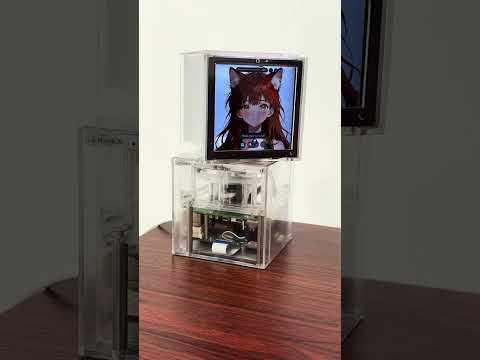
ClawStage is an open and modular hardware platform designed to allow OpenClaw to translate local intelligence into physical behavior.
It acts as a tangible shell for a single, persistent AI identity — providing the display, voice, sensors, and physical presence that allow an AI character to exist naturally in your home.
ClawStage does not define the AI’s personality or memory — it gives the AI a body.
This isn't just a smarter home. It's a home with a soul — one you created.

▶️ Watch the project overview: A Real AI Assistant is Here 🔥🔥

▶️ Watch the project overview: From Chat to Claw: ClawStage Brings OpenClaw Into the Physical World

When hosted on Stage, OpenClaw gains a continuous physical presence. Through voice, visual feedback, and environmental awareness, interactions feel more natural and emotionally grounded — closer to engaging with a living presence than issuing commands to a device.
The system integrates advanced multimodal technology with a Self-Evolving Memory Engine. This enables long-term, spatiotemporal memory, allowing the AI to remember your habits, preferences, and daily routines over time. Every interaction becomes a growth moment, refining how the AI understands you and responds.
As it learns, the AI gradually behaves like a thoughtful “super butler” — anticipating needs, adapting to patterns, and personalizing your home experience across devices. ClawStage enables these emotional and intelligent capabilities to manifest in the real world.
Powered by the built-in Home Assistant Hub in ClawStage, you can control multiple smart home devices through natural voice interaction — no manual operation required. It enables seamless interconnection across brands and protocols, making daily home life more efficient and hassle-free.
The AI character you create goes beyond a simple "voice assistant". Say something like “I’m so tired from work today”, and the AI can interpret intent and respond accordingly, such as adjusting lights or the indoor atmosphere to help you unwind.
▶️ Watch AI-driven device control in action

AI-Driven Device Control Demo #1 |

AI-Driven Device Control Demo #2 |
▶️ Watch the AI character follow your voice and turn to face you
▶️ Watch how the AI character reacts to its physical environment and responds to nearby events

Environment-Aware AI Interaction Demo |

Motion Feedback Demo |
AI characters can seamlessly move between devices — mobile apps, desktop environments, and ClawStage — while maintaining a unified memory and identity.
The AI exists on only one device at a time, “entering” and “exiting” different shells as needed. ClawStage is optimized to be the always-on physical home in this multi-device experience.
▶️ Watch the multi-device experience demo (app -> stage -> app -> desktop)
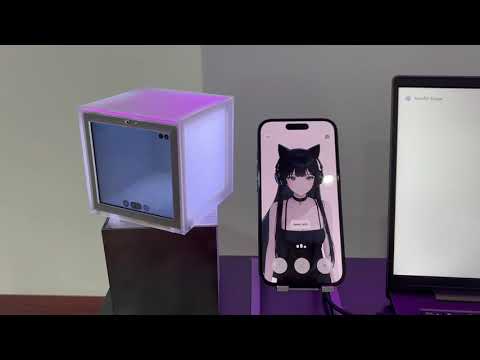
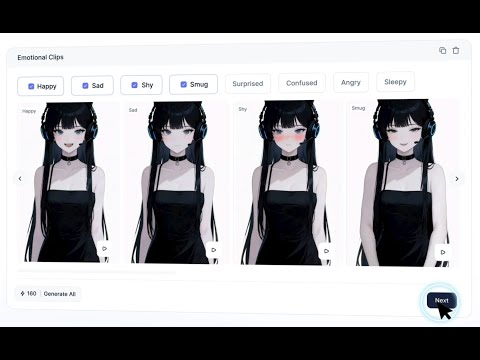
AI characters hosted on ClawStage are created and managed through HooRii Workshop, a platform that integrates key components such as ASR, LLM, TTS, and AI-based image and video generation, enabling rapid role creation and deployment without complex configurations.
When creating an AI character, you can fully customize it or choose from preset "independent personality" roles that simulate human-like behavior.
- Custom Mode — Design every trait from scratch.
- Platform Preset Mode — Start with curated personalities.
- Community Mode — Explore and adopt creations shared by others.
▶️ Watch a step-by-step UX demo of AI character creation and interaction
High-level hardware summary for ClawStage. Specifications may change with product revisions; see the PCB Revision Gallery section below for board-specific updates.
| Feature | Description |
|---|---|
| Product Dimensions | Enclosure 92 × 92 × 184 mm (L × W × H). |
| Processing Unit | Raspberry Pi 5 with 8 GB RAM. |
| Display | 3.95" capacitive touchscreen, 720 × 720 resolution, 800 nits brightness. |
| Microphone | Dual-microphone array, 65 dB(A) signal-to-noise ratio (SNR). |
| Speaker | Integrated 3 W mono speaker. |
| Servo | Operational rotation angle 5° to 175°. |
| Sensors | 3-axis MEMS accelerometer and ambient light sensor. |
| Camera | 1920 × 1080 (1080p), 83.9° field of view (FoV). |
| Storage | 32 GB microSD (included); M.2 NVMe, 2230 / 2242 form factors supported. |
| Cooling | Raspberry Pi 5 compatible bundled cooling fan. |
| Privacy Control | Hardware switch to enable or disable microphone and camera. |
| Power | USB Power Delivery (USB-PD) compatible power supply. |
ClawStage includes a hardware privacy switch so you can cut off sensing when you want the device not to see or hear. On the enclosure it sits just below the Ethernet connector. Flip it to enable or disable both the camera and the dual-microphone array together at the hardware level—without relying on software alone.
At a high level, muting the microphone means the microphone array is powered off and disconnected from the system. This hardware-based approach ensures that no audio can be captured or processed, even if software is running.
The circuit uses SW1 as the mute switch, SW2 as the mute-control enable selector, Q8 (AO3401A) to switch VDD_MIC, and U25 (74LVC125A) to gate the microphone digital interface.
Schematic: assets/schematics/SCH_Audio_XMOS_MuteControl.pdf.
⚠️ Note: PCB revisions may introduce design changes. Please refer to the PCB Revision Gallery for the latest details.
When mute is active, the microphone array is silenced in two ways:
- Power removed — Q8 disconnects VDD_MIC, powering down the microphone array.
- Digital interface gated — U25 disables the DATA and CLOCK paths so no valid microphone samples reach the processor.
Together, muting happens at both power and signal levels.
SW2 selects whether SW1 applies to the array, via MIC_EN_STAT:
MIC_EN_STAT = 1— the microphone array follows the mute switch (SW1).MIC_EN_STAT = 0— the microphone array is not controlled by SW1.
With SW2 set so that mute control applies, toggling SW1 removes VDD_MIC and gates the data/clock lines, fully muting the microphone array. With SW2 set to bypass mute control, SW1 does not affect the microphone array.
Below is an early ClawStage hardware prototype, illustrating the modular and extensible nature of the platform during development. The prototype integrates key components such as the compute module, display, camera, microphone array, and speakers, bringing AI characters into the physical world.

The images below show a more complete and assembled prototype, demonstrating how the hardware comes together as a standalone HomeAI device with an integrated display, enclosure, and I/O interfaces.


Top View |

Bottom View |

3D Render |
Overview
Rev B01 is the first fully integrated core PCB for ClawStage.
It establishes the baseline hardware architecture and validates the complete system design, including storage, power, and expansion interfaces.

Top View |

Bottom View |

3D Render |
Changes from Rev B01
- Simplified PCB layout by transitioning from a dual-sided design to a single-sided design
- Added interface support for an ambient light sensor
- Updated NVMe SSD support to include both M.2 2230 and 2242 form factors
- Reworked the power button to use Raspberry Pi native power control interface
- Enhanced the privacy switch to control both the microphone and camera simultaneously (previously microphone only)

Top View |

Bottom View |

3D Render |
Changes from Rev B02
- Added a dedicated microphone power selection switch; when enabled, microphone power is no longer controlled by the privacy switch
- Added a hardware factory reset button
- Introduced a fan connector and additional ventilation openings for improved thermal management
- Optimized connector placement and overall interface layout
- Fine-tuned audio circuit parameters for improved performance
Experience the future of belonging with AI.