
ConcurrentHashMap is a thread-safe implementation of the Map interface in Java that allows multiple threads to access and modify the map concurrently. It is part of the Java Collections Framework and is designed to provide better performance in multi-threaded environments compared to synchronized maps like Hashtable.
- Provides thread-safe operations without locking the entire map, improving concurrency.
- Allows multiple threads to read and write simultaneously with minimal blocking.
- Does not allow null keys or null values, preventing ambiguity in concurrent operations.
import java.util.concurrent.ConcurrentHashMap;

public class GFG {

    public static void main(String[] args)
    {
        ConcurrentHashMap<Integer, String> map
            = new ConcurrentHashMap<>();

        map.put(1, "Apple");
        map.put(2, "Banana");
        map.put(3, "Mango");

        System.out.println(map);
    }
}
Output
{1=Apple, 2=Banana, 3=Mango}
How ConcurrentHashMap Works Internally (Java 8+)
In earlier versions of Java (before Java 8), ConcurrentHashMap used segment-based locking. The map was divided into multiple segments, and each segment had its own lock to allow concurrent updates.
From Java 8 onwards, the segment-based architecture was removed. Instead, ConcurrentHashMap uses:
- CAS (Compare-And-Swap) operations for atomic updates.
- Fine-grained synchronization only when required.
- A structure similar to HashMap using Node arrays and buckets.
This design improves scalability and performance in highly concurrent environments.
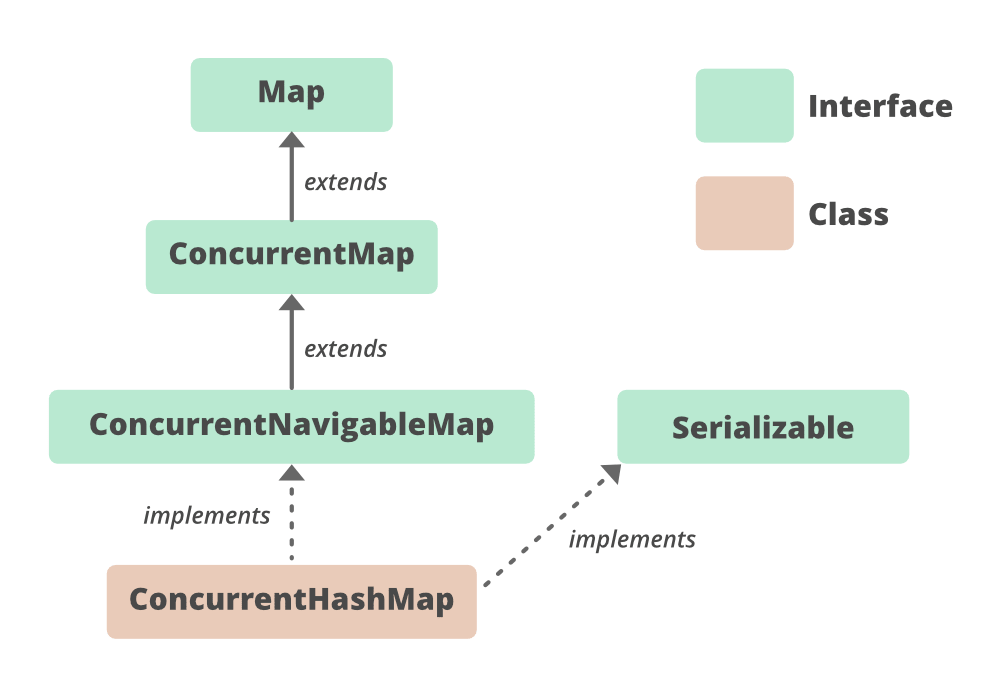
ConcurrentHashMap Hierarchy
It implements Serializable, ConcurrentMap<K, V>, Map<K, V> interfaces and extends AbstractMap<K, V> class.
Declaration of ConcurrentHashMap
In Java, the declaration of ConcurrentHashMap can be done as:
ConcurrentHashMap<KeyType, ValueType> map = new ConcurrentHashMap<>();
Note: Here the KeyType is the type of the key in the map and ValueType is the type of values associated with the keys.
Constructors of ConcurrentHashMap
ConcurrentHashMap provides several constructors to create a map with different initial configurations such as capacity, load factor, and concurrency level.
1. ConcurrentHashMap()
Creates an empty ConcurrentHashMap with default initial capacity and settings.
Syntax:
ConcurrentHashMap<K, V> map = new ConcurrentHashMap<>();
2. ConcurrentHashMap(int initialCapacity)
Creates a ConcurrentHashMap with the specified initial capacity.
Syntax:
ConcurrentHashMap<K, V> map = new ConcurrentHashMap<>(int initialCapacity);
3. ConcurrentHashMap(int initialCapacity, float loadFactor)
Creates a ConcurrentHashMap with the specified initial capacity and load factor.
Syntax:
ConcurrentHashMap<K, V> map = new ConcurrentHashMap<>(int initialCapacity, float loadFactor);
4. ConcurrentHashMap(int initialCapacity, float loadFactor, int concurrencyLevel)
Creates a ConcurrentHashMap with specified initial capacity, load factor, and estimated number of concurrently updating threads.
Syntax:
ConcurrentHashMap<K, V> map = new ConcurrentHashMap<>(int initialCapacity, float loadFactor, int concurrencyLevel);
5. ConcurrentHashMap(Map<? extends K, ? extends V> m)
Creates a ConcurrentHashMap containing all mappings from the specified map.
Syntax:
ConcurrentHashMap<K, V> map = new ConcurrentHashMap<>(Map m);
Example: This example demonstrates the usage of various ConcurrentHashMap methods.
import java.util.concurrent.*;
class Geeks {

    public static void main(String[] args)
    {
        // create an instance of
        // ConcurrentHashMap
        ConcurrentHashMap<Integer, String> m
            = new ConcurrentHashMap<>();

        // Insert mappings using
        // put method
        m.put(100, "Hello");
        m.put(101, "Geeks");
        m.put(102, "Geeks");

        // Here we cant add Hello because 101 key
        // is already present in ConcurrentHashMap object
        m.putIfAbsent(101, "Hello");

        // We can remove entry because 101 key
        // is associated with For value
        m.remove(101, "Geeks");

        // Now we can add Hello
        m.putIfAbsent(103, "Hello");

        // We cant replace Hello with For
        m.replace(101, "Hello", "For");
        System.out.println(m);
    }
}
Output
{100=Hello, 102=Geeks, 103=Hello}
Performing Various Operations on ConcurrentHashMap
1. Adding Elements: We can use put() or putAll() to insert element to a ConcurrentHashMap.
import java.util.concurrent.*;
public class Geeks{

    public static void main(String[] args) {
        // Create ConcurrentHashMap
        ConcurrentHashMap<String, String> map1 = new ConcurrentHashMap<>();

        // Add elements to map
        map1.put("1", "One");
        map1.put("2", "Two");
        map1.put("3", "Three");
        map1.put("4", "Four");
        map1.put("5", "Five");
        map1.put("6", "Six");

        // Print map1
        System.out.println("map1: " + map1);

        // Create a new map and copy all entries from map1
        ConcurrentHashMap<String, String> map2 = new ConcurrentHashMap<>(map1);

        // Print map2
        System.out.println("map2: " + map2);
    }
}
Output
map1: {1=One, 2=Two, 3=Three, 4=Four, 5=Five, 6=Six}
map2: {1=One, 2=Two, 3=Three, 4=Four, 5=Five, 6=Six}
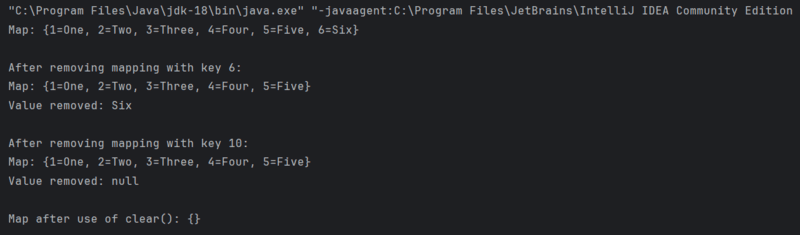
2. Removing Elements: We can use the remove() method to remove elements from the ConcurrentHashMap. To clear the entire map, we can use the clear().
import java.util.*;
import java.util.concurrent.ConcurrentHashMap;

public class Geeks{

    public static void main(String[] args)
    {
        // Creating ConcurrentHashMap
        Map<String, String> m
                = new ConcurrentHashMap<String, String>();

        // Adding elements to the map
        // using put() method
        m.put("1", "One");
        m.put("2", "Two");
        m.put("3", "Three");
        m.put("4", "Four");
        m.put("5", "Five");
        m.put("6", "Six");

        System.out.println("Map: " + m);
        System.out.println();

        // Removing the mapping
        // with existing key 6
        // using remove() method
        String s = m.remove("6");

        // Printing the map after remove()
        System.out.println(
                "After removing mapping with key 6:");
        System.out.println("Map: " + m);
        System.out.println("Value removed: "
                + s);
        System.out.println();

        // Removing the mapping
        // with non-existing key 10
        // using remove() method
        s = m.remove("10");

        // Printing the map after remove()
        System.out.println(
                "After removing mapping with key 10:");
        System.out.println("Map: " + m);
        System.out.println("Value removed: "
                + s);
        System.out.println();

        // Now clear the map using clear()
        m.clear();

        System.out.println("Map after use of clear(): "
                + m);
    }
}
Output:
3. Accessing Elements: We can use the get() method to access the elements of the ConcurrentHashMap.
import java.util.concurrent.*;
class Geeks {
    public static void main(String[] args)
    {

        // create an instance of ConcurrentHashMap
        ConcurrentHashMap<Integer, String> m
                = new ConcurrentHashMap<Integer, String>();

        // insert mappings using put method
        m.put(100, "Geeks");
        m.put(101, "for");
        m.put(102, "Geeks");
        m.put(103, "Contribute");

        // Displaying the HashMap

        System.out.println("ConcurrentHashMap:" + m);

        // Display the value of 100
        System.out.println("The Value associated to "
                + "100 is : " + m.get(100));

        // Getting the value of 103
        System.out.println("The Value associated to "
                + "103 is : " + m.get(103));
    }
}
Output
ConcurrentHashMap:{100=Geeks, 101=for, 102=Geeks, 103=Contribute}
The Value associated to 100 is : Geeks
The Value associated to 103 is : Contribute
4. Iterating Elements: We can use the Iterator interface to traverse over the elements of ConcurrentHashMap.
import java.util.*;
import java.util.concurrent.*;
public class Geeks {
    public static void main(String[] args)
    {
        // create an instance of ConcurrentHashMap
        ConcurrentHashMap<Integer, String> m
                = new ConcurrentHashMap<Integer, String>();

        // Add elements using put()
        m.put(8, "Third");
        m.put(6, "Second");
        m.put(3, "First");
        m.put(11, "Fourth");

        // Create an Iterator over the
        // ConcurrentHashMap
        Iterator<ConcurrentHashMap.Entry<Integer, String> >
                i = m.entrySet().iterator();

        // The hasNext() method is used to check if there is
        // a next element The next() method is used to
        // retrieve the next element
        while (i.hasNext()) {
            ConcurrentHashMap.Entry<Integer, String> entry
                    = i.next();
            System.out.println("Key = " + entry.getKey()
                    + ", Value = "
                    + entry.getValue());
        }
    }
}
Output
Key = 3, Value = First
Key = 6, Value = Second
Key = 8, Value = Third
Key = 11, Value = Fourth
Methods of ConcurrentHashMap
Methods | Description |
|---|---|
| clear() | Removes all of the mappings from this map. |
| compute(K key, BiFunction<? super K,? super V,? extends V> remappingFunction) | Attempts to compute a mapping for the specified key and its current mapped value (or null if there is no current mapping). |
| computeIfAbsent(K key, Function<? super K,? extends V> mappingFunction) | If the specified key is not already associated with a value, attempts to compute its value using the given mapping function and enters it into this map unless null. |
| computeIfPresent(K key, BiFunction<? super K,? super V,? extends V> remappingFunction) | If the value for the specified key is present, attempts to compute a new mapping given the key and its current mapped value. |
| contains(Object value) | Tests if some keymaps into the specified value in this table. |
| containsKey(Object key) | Tests if the specified object is a key in this table. |
| containsValue(Object value) | Returns true if this map maps one or more keys to the specified value. |
| elements() | Returns an enumeration of the values in this table. |
| entrySet() | Returns a Set view of the mappings contained in this map. |
| equals(Object o) | Compares the specified object with this map for equality. |
| forEach(long parallelismThreshold, BiConsumer<? super K,? super V> action) | Performs the given action for each (key, value). |
| forEach(long parallelismThreshold, BiFunction<? super K,? super V,? extends U> transformer, Consumer<? super U> action) | Performs the given action for each non-null transformation of each (key, value). |
| forEachEntry(long parallelismThreshold, Consumer<? super Map.Entry<K,V>> action) | Performs the given action for each entry. |
| forEachEntry(long parallelismThreshold, Function<Map.Entry<K,V>,? extends U> transformer, Consumer<? super U> action) | Performs the given action for each non-null transformation of each entry. |
| forEachKey(long parallelismThreshold, Consumer<? super K> action) | Performs the given action for each key. |
| forEachKey(long parallelismThreshold, Function<? super K,? extends U> transformer, Consumer<? super U> action) | Performs the given action for each non-null transformation of each key. |
| forEachValue(long parallelismThreshold, Consumer<? super V> action) | Performs the given action for each value. |
| forEachValue(long parallelismThreshold, Function<? super V,? extends U> transformer, Consumer<? super U> action) | Performs the given action for each non-null transformation of each value. |
| get(Object key) | Returns the value to which the specified key is mapped, or null if this map contains no mapping for the key. |
| getOrDefault(Object key, V defaultValue) | Returns the value to which the specified key is mapped, or the given default value if this map contains no mapping for the key. |
| hashCode() | Returns the hash code value for this Map, i.e., the sum of, for each key-value pair in the map, key.hashCode() ^ value.hashCode(). |
| keys() | Returns an enumeration of the keys in this table. |
| keySet() | Returns a Set view of the keys contained in this map. |
| keySet(V mappedValue) | Returns a Set view of the keys in this map, using the given common mapped value for any additions (i.e., Collection.add(E) and Collection.addAll(Collection)). |
| mappingCount() | Returns the number of mappings. |
| merge(K key, V value, BiFunction<? super V,? super V,? extends V> remappingFunction) | If the specified key is not already associated with a (non-null) value, associates it with the given value. |
| newKeySet() | Creates a new Set backed by a ConcurrentHashMap from the given type to Boolean.TRUE. |
| newKeySet(int initialCapacity) | Creates a new Set backed by a ConcurrentHashMap from the given type to Boolean.TRUE. |
| put(K key, V value) | Maps the specified key to the specified value in this table. |
| putAll(Map<? extends K,? extends V> m) | Copies all of the mappings from the specified map to this one. |
| putIfAbsent(K key, V value) | If the specified key is not already associated with a value, associates it with the given value. |
| reduce(long parallelismThreshold, BiFunction<? super K,? super V,? extends U> transformer, BiFunction<? super U,? super U,? extends U> reducer) | Returns the result of accumulating the given transformation of all (key, value) pairs using the given reducer to combine values, or null if none. |
| reduceEntries(long parallelismThreshold, BiFunction<Map.Entry<K,V>,Map.Entry<K,V>,? extends Map.Entry<K,V>> reducer) | Returns the result of accumulating all entries using the given reducer to combine values, or null if none. |
| reduceEntries(long parallelismThreshold, Function<Map.Entry<K,V>,? extends U> transformer, BiFunction<? super U,? super U,? extends U> reducer) | Returns the result of accumulating the given transformation of all entries using the given reducer to combine values, or null if none. |
| reduceEntriesToDouble(long parallelismThreshold, ToDoubleFunction<Map.Entry<K,V>> transformer, double basis, DoubleBinaryOperator reducer) | Returns the result of accumulating the given transformation of all entries using the given reducer to combine values, and the given basis as an identity value. |
| reduceEntriesToInt(long parallelismThreshold, ToIntFunction<Map.Entry<K,V>> transformer, int basis, IntBinaryOperator reducer) | Returns the result of accumulating the given transformation of all entries using the given reducer to combine values, and the given basis as an identity value. |
| reduceEntriesToLong(long parallelismThreshold, ToLongFunction<Map.Entry<K,V>> transformer, long basis, LongBinaryOperator reducer) | Returns the result of accumulating the given transformation of all entries using the given reducer to combine values, and the given basis as an identity value. |
| reduceKeys(long parallelismThreshold, BiFunction<? super K,? super K,? extends K> reducer) | Returns the result of accumulating all keys using the given reducer to combine values, or null if none. |
| reduceKeys(long parallelismThreshold, Function<? super K,? extends U> transformer, BiFunction<? super U,? super U,? extends U> reducer) | Returns the result of accumulating the given transformation of all keys using the given reducer to combine values, or null if none. |
| reduceKeysToDouble(long parallelismThreshold, ToDoubleFunction<? super K> transformer, double basis, DoubleBinaryOperator reducer) | Returns the result of accumulating the given transformation of all keys using the given reducer to combine values, and the given basis as an identity value. |
| reduceKeysToInt(long parallelismThreshold, ToIntFunction<? super K> transformer, int basis, IntBinaryOperator reducer) | Returns the result of accumulating the given transformation of all keys using the given reducer to combine values, and the given basis as an identity value. |
| reduceKeysToLong(long parallelismThreshold, ToLongFunction<? super K> transformer, long basis, LongBinaryOperator reducer) | Returns the result of accumulating the given transformation of all keys using the given reducer to combine values, and the given basis as an identity value. |
| reduceToDouble(long parallelismThreshold, ToDoubleBiFunction<? super K,? super V> transformer, double basis, DoubleBinaryOperator reducer) | Returns the result of accumulating the given transformation of all (key, value) pairs using the given reducer to combine values, and the given basis as an identity value. |
| reduceToInt(long parallelismThreshold, ToIntBiFunction<? super K,? super V> transformer, int basis, IntBinaryOperator reducer) | Returns the result of accumulating the given transformation of all (key, value) pairs using the given reducer to combine values, and the given basis as an identity value. |
| reduceToLong(long parallelismThreshold, ToLongBiFunction<? super K,? super V> transformer, long basis, LongBinaryOperator reducer) | Returns the result of accumulating the given transformation of all (key, value) pairs using the given reducer to combine values, and the given basis as an identity value. |
| reduceValues(long parallelismThreshold, BiFunction<? super V,? super V,? extends V> reducer) | Returns the result of accumulating all values using the given reducer to combine values, or null if none. |
| reduceValues(long parallelismThreshold, Function<? super V,? extends U> transformer, BiFunction<? super U,? super U,? extends U> reducer) | Returns the result of accumulating the given transformation of all values using the given reducer to combine values, or null if none. |
| reduceValuesToDouble(long parallelismThreshold, ToDoubleFunction<? super V> transformer, double basis, DoubleBinaryOperator reducer) | Returns the result of accumulating the given transformation of all values using the given reducer to combine values, and the given basis as an identity value. |
| reduceValuesToInt(long parallelismThreshold, ToIntFunction<? super V> transformer, int basis, IntBinaryOperator reducer) | Returns the result of accumulating the given transformation of all values using the given reducer to combine values, and the given basis as an identity value. |
| reduceValuesToLong(long parallelismThreshold, ToLongFunction<? super V> transformer, long basis, LongBinaryOperator reducer) | Returns the result of accumulating the given transformation of all values using the given reducer to combine values, and the given basis as an identity value. |
| remove(Object key) | Removes the key (and its corresponding value) from this map. |
| remove(Object key, Object value) | Removes the entry for a key only if currently mapped to a given value. |
| replace(K key, V value) | Replaces the entry for a key only if currently mapped to some value. |
| replace(K key, V oldValue, V newValue) | Replaces the entry for a key only if currently mapped to a given value. |
| search(long parallelismThreshold, BiFunction<? super K,? super V,? extends U> searchFunction) | Returns a non-null result from applying the given search function on each (key, value), or null if none. |
| searchEntries(long parallelismThreshold, Function<Map.Entry<K,V>,? extends U> searchFunction) | Returns a non-null result from applying the given search function on each entry, or null if none. |
| searchKeys(long parallelismThreshold, Function<? super K,? extends U> searchFunction) | Returns a non-null result from applying the given search function on each key, or null if none. |
| searchValues(long parallelismThreshold, Function<? super V,? extends U> searchFunction) | Returns a non-null result from applying the given search function on each value, or null if none. |
| toString() | Returns a string representation of this map. |
| values() | Returns a Collection view of the values contained in this map. |
Methods Declared in Class java.util.AbstractMap
Method | Description |
|---|---|
| clone() | Returns a shallow copy of this AbstractMap instance: the keys and values themselves are not cloned. |
| isEmpty() | Returns true if this map contains no key-value mappings. |
| size() | Returns the number of key-value mappings in this map. |
Methods Declared in Interface java.util.concurrent.ConcurrentMap
Method | Description |
|---|---|
| forEach(BiConsumer<? super K,? super V> action) | Performs the given action for each entry in this map until all entries have been processed or the action throws an exception. |
| replaceAll(BiFunction<? super K,? super V,? extends V> function) | Replaces each entry's value with the result of invoking the given function on that entry until all entries have been processed or the function throws an exception. |