This year is nine years since I finished my Ph.D -- a thesis which for all its flaws would eventually go on to be the book Theology, Horror and Fiction: A Reading of the Gothic Nineteenth Century. I ended up leaving academia in 2022, after writing a couple of books, around a dozen book chapters and articles and winning around $200,000 of research funding. By most measures of the neoliberal academy, I think I had started to build something pretty solid in terms of an academic career, but it wasn’t enough. What’s interesting is one of the most common questions I get when someone finds out about that particular chapter of my professional life: “do you miss it?” Over the initial couple of years -- actually until relatively recently -- my reaction was a visceral and emotionally raw ”yes,” but as time has wound onwards, there really is only one major thing I find myself still grieving. For all of the problems of academia as a place to work there is something that remains really valuable. Time. Whittled away though it might be by an overbearing managerialism, the idea of academic work as one that requires time to read, write, think and teach remains true.
I’ve been thinking about this a lot lately as much of my current work doesn’t really depend on finishing, completing or posting things, but reckoning with all the things I want to do, but don’t have the time for. The series on the Haunted House on Film needs a new installment, there are new episodes of Horror Vanguard to try and make, (go listen to the episode on Red Rooms) I desperately want to get a couple of book proposals finished (perhaps even accepted somewhere), there are books and exhibitions I want to write about (go see the Emin retrospective at the Tate Modern, I beg) and I have Youtube scripts sitting in a computer folder that need finishing, gameplay capturing and editing. The thing I find myself muttering to myself again and again is that I don’t have time for this.
So much of life, mediated as it is by the monopoly platforms of digital capitalism, seems to boil down to an inescapable feeling of always being behind, and of always apologizing that the thing I said I was really excited about doing months ago hasn’t yet appeared. The structures of the internet further incentivize thinking of any kind of writing as a matter of production rather than process. Internalize this deeply enough and time becomes something to be managed, its flow optimized and the human, all too human inefficiencies of being become something that one should condition out of existence.
This is the promise of AI in a nutshell. The now-ubiquitous predictive models of language generation promise greater output, promise immediacy and promise an eradication of the friction that exists between the idea and the actual. The problems with them are fairly well known by now: the exploitative, psychologically tortuous labor of data annotation, the environmental racism of data centers, the structural intensification of algorithmic racism and so on and so on. I’ve had all of my books stolen by mega-corperations and their excuse is that now I can generate as many books in my tone of voice as I ever could wish. On a deep-seated level, whenever I see this shit, whenever I’m told I should be using it, whenever another discursive cycle around it kicks off, the only thing I can feel is a deep seated moral repugnance. It’s why reading Becca Rothfeld’s latest newsletter installment was so appealing. Becca’s piece is so good and helpful because it correctly identifies two really important things. Firstly, even if AI has some specific, focused and generally quantifiable use cases, generalized mass adoption is predicated upon artificial demand, and secondly the use of AI in this way is profoundly anti-human. Write me a card, tell me how my co-worker might feel, release me from the burden of my own sense of freedom. I do not wish to live this way. I remember reading the work of my friend and comrade Nolen Gertz on the philosophy of technology. The problem of technology for Gertz, was not that it would take away our freedom, but that we would all too willingly just give it up because we cannot think of being otherwise.
Something that’s often flung at critics of so-called AI is that they’re simply anti-technology but the technology isn’t the primary issue - rather, the wider problem is the structural imposition of artificial demand. There is no general bottom up demand or interest in AI - we’re told over and over again that the technology is simply inevitable, that the only thing to do is to adapt or be left behind. AI is less a technology for generating text and more a disciplinary mechanism for keeping employees on a short lease while inculcating in them a sense of their own inherent disposability. Bosses love AI, while actual workers recognise it for what it is - a machine for the escalation and acceleration of the demand to be ever more productive or else. But writing is not an output based activity - what the writer Richard Seymour would call the scripturiant impulse for ever more unspooling amounts of text. Rather, writing, like so many other forms of creativity, is not really about the end point or output, but the unquantifiable, qualitative process by which human consciousness projects itself out into our shared life-world.
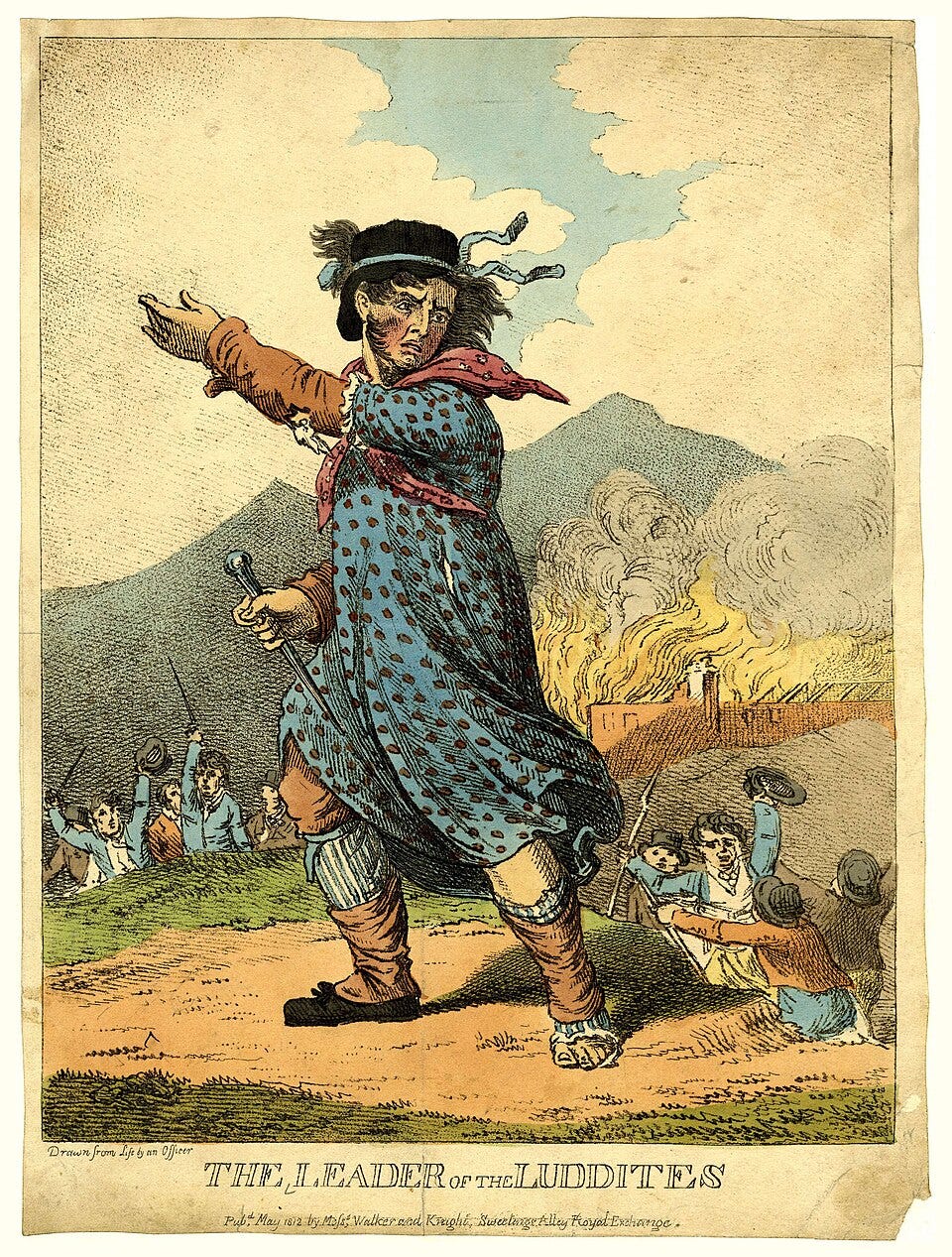
The moral repugnance I feel when reading AI generated material isn’t from some knee-jerk Luddism, or lack of knowledge or fear of the technology. Rather, the feeling is a symptom of the ways in which the time and space for people to think and to write and to create is snatched in fleeting bursts from the demand to be ever more productive. The imperative to use AI to create is an attempt to frame a problem of politics as a problem of efficiency. I do not need to be more efficient, I need time and freedom to read and to think and to write and to fail as we all do. Writing is the visible sign of thought in motion, and the freedom to pursue thought is not one granted through centralised tech monopolies. I spent a couple of years after leaving academia writing about the philosopher and Utopian Ernst Bloch, and in his work, as with many Marxists, there was a strong strain of Prometheanism - the idea that technology could be a liberatory force. Like so many of the Utopian ideas of the twentieth century, the horizon of modernity is necessarily more modest now. I think it starts with insisting on the necessity of friction and boredom and struggle to bring something from the isolated imagination onto that page. Show me a model that can generate writing and all I can think is I don’t have time for this.