A modular, coverage-guided, gray-box fuzzing framework written in Python. This project aims to demonstrate and implement a modern fuzzer by combining the high-level logic of Python with a powerful, low-level binary instrumentation tool (DynamoRIO).
This project is ideal for students, researchers, and security enthusiasts interested in software security, vulnerability discovery, and systems programming.
This fuzzer employs an efficient hybrid architecture to maximize the advantages of different tools and languages:
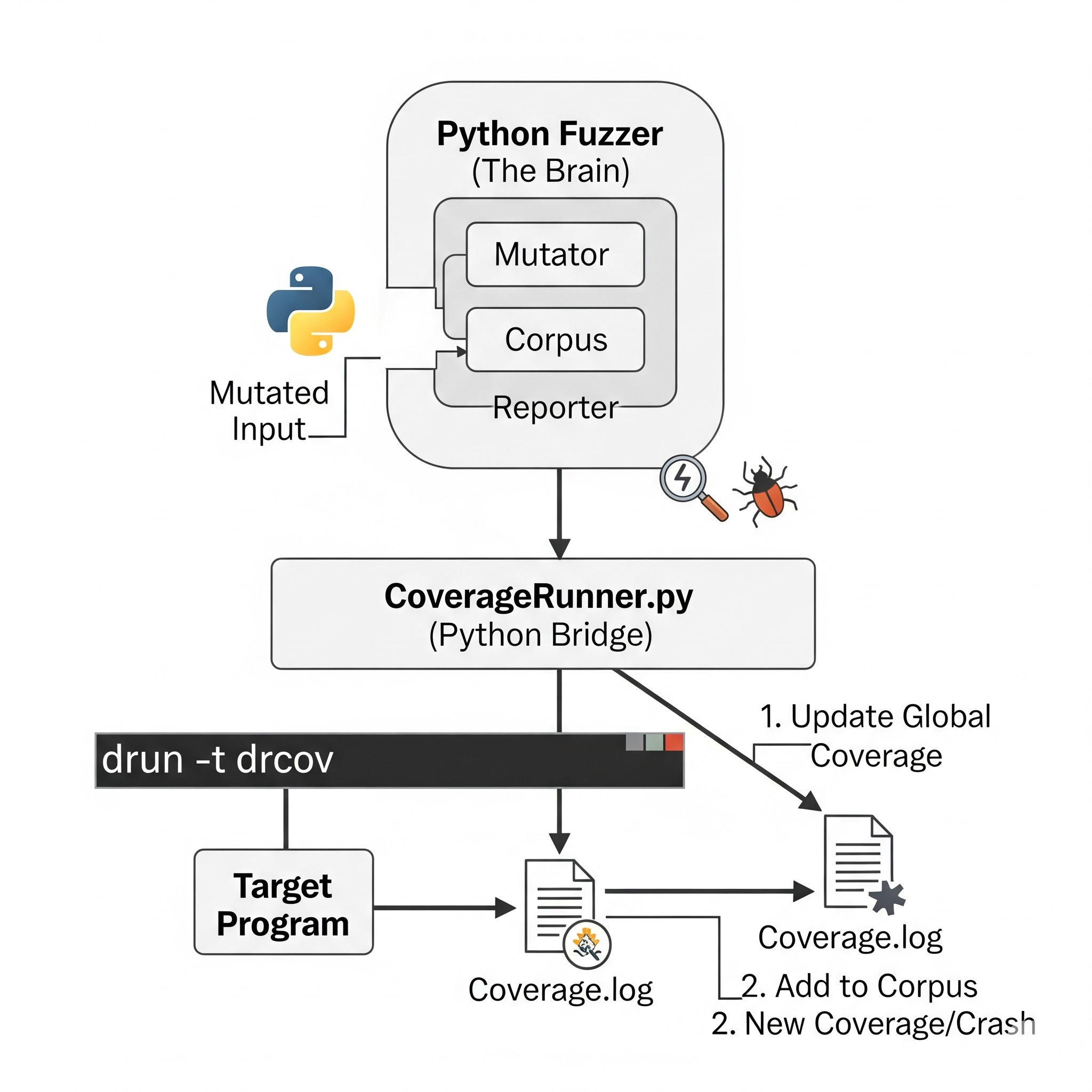
- Python (The Brain): Handles all high-level logic, including mutation strategies, corpus scheduling, crash reporting, and evolutionary decisions.
- DynamoRIO (The Eyes): Acts as a high-performance, external Dynamic Binary Instrumentation (DBI) engine. It monitors the target's execution and generates code coverage logs without needing to recompile the source code.
- CoverageRunner (The Bridge): A Python module responsible for invoking the target program under DynamoRIO, then parsing the resulting coverage logs to feed critical information (executed basic blocks) back to the brain.
- Coverage-Guided Engine: Intelligently steers the fuzzing process based on new code paths discovered via DynamoRIO, moving beyond blind mutations to efficiently explore deep program logic.
- Evolutionary Corpus: Automatically adds "elite" inputs—those that trigger new code paths or unique crashes—to the corpus, enabling a genetic algorithm approach for continuous evolution.
- Smart Crash Deduplication: Utilizes "crash fingerprints" (composed of
status+return code+key error message) to ensure that only samples representing novel program behaviors are reported and saved. - Highly Modular Design: Core components (
Mutator,Runner,Corpus,Reporter) are decoupled for clarity, easy maintenance, and extensibility. - Out-of-the-Box: Ready to start fuzzing once provided with a target binary and initial seeds.
-
Python 3:
- Ensure you have Python 3.7 or newer installed.
-
C++ Compiler:
- Required for compiling the example targets.
g++is recommended. - On Debian/Ubuntu:
sudo apt-get install build-essential
- Required for compiling the example targets.
-
DynamoRIO:
- Download the latest release from the official GitHub: DynamoRIO Releases
- It's recommended to download a
DynamoRIO-Linux-X.X.X.tar.gzpackage. - Extract it to a stable location, e.g.,
~/dynamorio/. For convenience, you can add itsbin64directory to yourPATH.
Launch the fuzzer from the command line with the required arguments.
python3 main.py -D <path_to_dynamorio> -i <input_corpus> -c <crash_dir> -n <iterations> -- <target_program> [args...]Arguments:
-D, --dynamorio: (Required) The root path of your DynamoRIO installation (e.g.,~/dynamorio).target: (Required) The target program and its arguments. Must be placed after--.-i, --input: (Required) Path to the initial seed corpus directory.-c, --crashes: Path to the directory for storing unique crash samples (default:./crashes).-n, --iterations: The maximum number of fuzzing iterations (default:10000).-t, --timeout: Timeout in seconds for each execution run (default:5).
Let's use the fuzzer to find a heap overflow vulnerability caused by an integer overflow.
-
Prepare the Vulnerable Program: Compile the
target_int_overflow.cppfile included in this project.g++ target_int_overflow.cpp -o target_int_overflow -g
-
Prepare an Initial Seed: Create a simple seed file.
mkdir -p inputs
echo -n "INIT" > inputs/seed.txt
-
Launch the Fuzzer: Assuming DynamoRIO is located at
~/dynamorio.python3 main.py -D ~/dynamorio -i ./inputs -c ./crashes -n 50000 -- ./target_int_overflow -
Interpret the Results: The fuzzer will run, and its status line will show the corpus and coverage growing over time. Eventually, it will generate an input where the first two bytes are
\xff\xff(65535), triggering the vulnerability.A unique crash report will appear on your console:
[!!!] UNIQUE BEHAVIOR DETECTED! Fingerprint: ('crash', -6, 'free(): corrupted size vs. prev_size') [*] Saved to 'crashes/UNIQUE_crash_rc-6_...'- The Fingerprint:
rc-6(SIGABRT) combined with thefree()error message clearly points to a heap corruption vulnerability. - The
crashesdirectory: You will find the corresponding.inputand.logfiles, which you can use for in-depth offline analysis with tools likegdb.
- The Fingerprint: