
In this tutorial, I will explain how to use the Python Pass function. Someone asked me this question during a Python webinar and I explored about pass function and decided to write this article. Let us learn more about this topic today.
Pass Function in Python
The pass statement in Python is a placeholder that signifies that a particular code block is empty or yet to be written. It is used when you need to define a function, class, or loop without providing any implementation details.
For example, let’s say you’re working on a project for a client in New York, and you need to define a function called calculate_taxes(). However, you don’t have the tax calculation logic ready yet. You can use the pass function as a placeholder:
def calculate_taxes():
    pass
By using the pass function, you can define the calculate_taxes() function without any implementation, allowing your code to run without errors.
Examples
Let’s explore some examples of using the pass function in different scenarios.
Example 1: Placeholder for Future Code
Suppose you’re working on a project for a client in Chicago, and you need to define a class called Customer. However, you haven’t determined the attributes and methods of the class yet. You can use the pass function as a placeholder:
class Customer:
    pass
This allows you to define the Customer class without any implementation details, serving as a placeholder for future code.
Check out How to Create an Empty Set in Python
Example 2: Empty Code Blocks
Consider a scenario where you’re developing a web application for a company in Los Angeles. You have a function that handles user authentication, but you haven’t implemented the logic yet. You can use the pass function to define an empty code block:
def authenticate_user(username, password):
    if username == "admin" and password == "secret":
        # TODO: Implement authentication logic
        pass
    else:
        print("Invalid credentials")
I have executed the above example code and added the screenshot below.
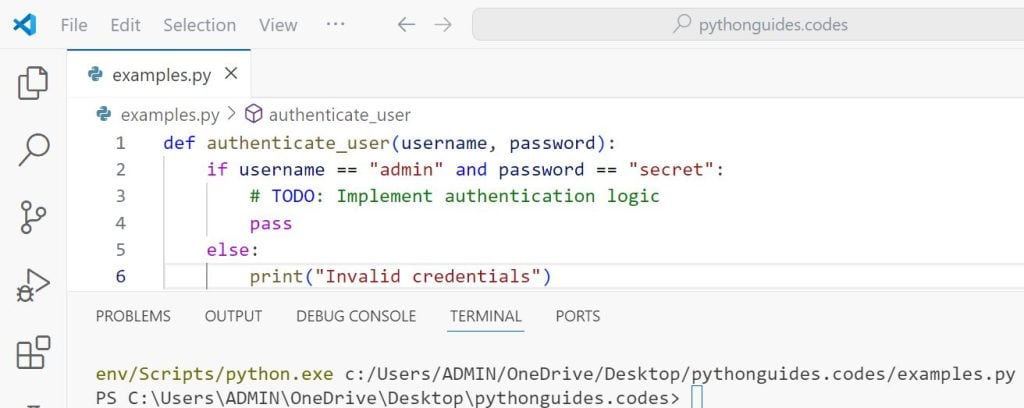
In this example, the pass function is used as a placeholder for the authentication logic that will be implemented later.
Read How to Sort an Array in Python?
Example 3: Debugging and Testing
Let’s say you’re working on a data analysis project for a client in Houston. You have a complex function that performs various calculations, but you want to temporarily disable a specific code block for debugging purposes. You can use the pass function to skip the execution of that code block:
def analyze_data(data):
    # Perform initial data preprocessing
    preprocessed_data = preprocess(data)

    # Temporarily disable the analysis code block
    pass
    # analysis_result = perform_analysis(preprocessed_data)

    # Generate report
    generate_report(preprocessed_data)
By using the pass function, you can effectively skip the analysis code block without deleting it, allowing you to focus on debugging other parts of the function.
Check out How to Check if an Array Contains a Value in Python
Best Practices to Use the Python Pass Function
When using the pass function in your Python code, keep the following best practices in mind:
- Use Meaningful Comments: When using the pass function as a placeholder, add meaningful comments to indicate the purpose of the code block and what needs to be implemented in the future. This helps other developers (and yourself) understand the intended functionality.
- Replace Pass with Actual Code: Once you have the implementation details ready, make sure to replace the pass function with the actual code. Leaving pass statements in your final code can make it harder to understand and maintain.
- Avoid Overusing Pass: While the pass function is useful in certain situations, avoid overusing it. If you find yourself using pass extensively, it may indicate that you need to revisit your code structure and design.
Read How to Reverse an Array in Python
Conclusion
In this tutorial, I helped you to understand how to use the Python Pass function. I discussed the pass function in Python, examples to placeholder for future code, empty code blocks, debugging and testing, and best practices for using the Python pass function.
You may also like to read:
- How to Initialize a 2D Array in Python?
- How to Check if an Array is Empty in Python?
- How to Create Arrays in Python?

I am Bijay Kumar, a Microsoft MVP in SharePoint. Apart from SharePoint, I started working on Python, Machine learning, and artificial intelligence for the last 5 years. During this time I got expertise in various Python libraries also like Tkinter, Pandas, NumPy, Turtle, Django, Matplotlib, Tensorflow, Scipy, Scikit-Learn, etc… for various clients in the United States, Canada, the United Kingdom, Australia, New Zealand, etc. Check out my profile.

